

Introduction
A friend recently decided to start learning the piano and began looking for a "home instrument." However, he immediately faced a difficult dilemma: should he buy an Upright Piano or a Grand Piano?
The price gap is staggering. A decent quality upright can be found for a few thousand to ten thousand dollars, whereas an entry-level grand piano often costs four or five times that amount.
Why is there such a disparity in price between these two members of the "Piano Family"? What exactly are the differences in their shape, structure, and function? Below, we break down the key distinctions to help answer these questions for you (and my friend).
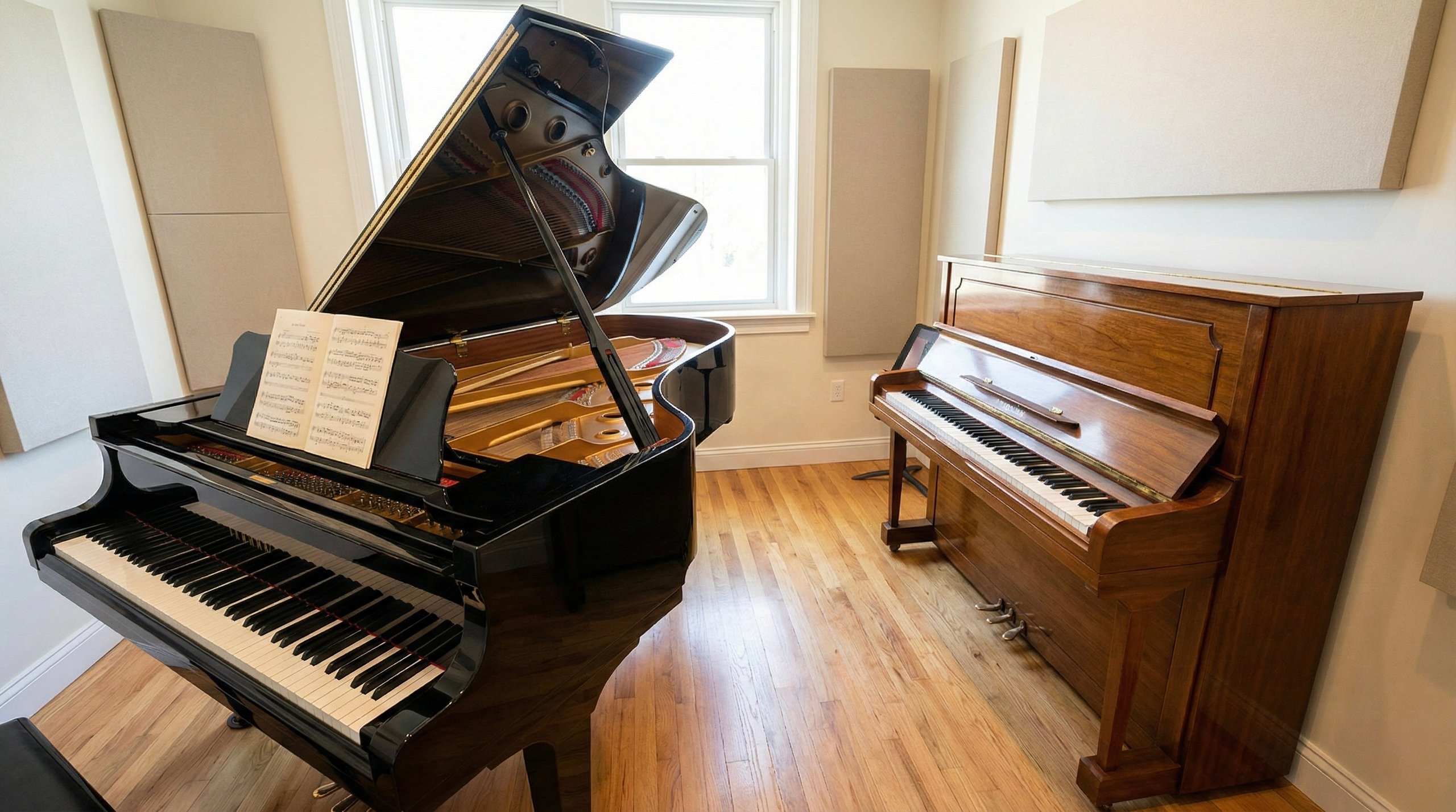
1. Appearance: Space and Visual Impact
The most obvious difference lies in the volume and shape of the instruments.
The Grand Piano (Horizontal):
The strings and soundboard are placed horizontally. The body is long and requires a significant amount of floor space. In fact, the footprint of a single grand piano is large enough to fit two to four upright pianos, depending on the size. In cities with limited living space (like Hong Kong), few households can spare an entire room just for a grand piano. Additionally, grand pianos feature a top lid that opens upward, projecting sound outward and creating a majestic, stage-like aesthetic.
The Upright Piano (Vertical):
Designed for compactness, the strings and soundboard run vertically. This design takes up significantly less floor area, allowing the piano to sit flush against a wall. For most families adding a piano to a living room or study, the upright is the logical choice for saving space. Its lid is usually fixed or opens slightly at the top, meaning sound projects primarily from the back or top of the casing, resulting in a simpler, more modest appearance.
2. The Mechanics: Action and Physics
The piano is far more complex than it looks, containing an action mechanism made of thousands of parts. While both types use hammers to strike strings, the physics behind them create a completely different playing experience.
A. The "Action" Complexities (Speed)
The most significant technological breakthrough in piano history was the "Double Escapement" action invented by Sébastien Érard.
Grand Piano: Utilizing the double escapement system, a grand piano key only needs to return about 1–2 mm before it can be played again. This allows a pianist to play up to 14 repetitions per second. The sound is continuous, rapid, and responsive.
Upright Piano: Because of its vertical design, the key usually needs to return almost fully (about 5–6 mm) before the hammer resets. This limits the repetition speed to about 7 times per second.
The Result: The Grand Piano has a distinct advantage in rapid trills, repeating notes, and fast, virtuosic passages.
B. Gravity vs. Springs (Control)
Grand Piano (Gravity): The hammers in a grand piano return to their resting position using natural gravity. This provides a consistent, balanced weight. From a physics perspective, gravity ensures a nuanced and stable striking force.
Upright Piano (Springs): Because the hammers move horizontally, they cannot rely on gravity to return; they rely on springs. Springs can have inconsistent tension and wear out over time. This can lead to uneven touch or difficulty controlling dynamics during fast or sustained playing.
3. The Pedals: Function and Tone
While most modern pianos have three pedals, their specific functions—especially the middle pedal—differ greatly between the two types.
The Left Pedal (Soft Pedal / Una Corda)
Grand Piano (Una Corda): The entire keyboard and hammer mechanism shifts sideways. The hammers strike fewer strings (or a softer part of the hammer felt), changing the timbre and creating a true change in tone color.
Upright Piano (Soft Pedal): The hammer rail moves closer to the strings (reducing the distance from ~46mm to ~23mm). This reduces the force of impact and volume, but it does not significantly change the tone color.
The Middle Pedal
Grand Piano (Sostenuto): This acts as a selective sustain. It sustains only the notes held down at the moment the pedal is pressed, allowing the pianist to play staccato notes on top of a sustained bass chord.
Upright Piano (Mute/Practice Rail): This lowers a strip of felt between the hammers and strings. It muffles the sound to about 1/3 of the normal volume, functioning as a "practice mode" to avoid disturbing neighbors.
The Right Pedal (Damper/Sustain)
Both: The function is similar (lifting all dampers to let strings vibrate).
Difference: Grand piano pedals generally offer a wider range of sensitivity, allowing for "half-pedaling" and more subtle color changes compared to the often binary (on/off) feel of some uprights.
-------------
Conclusion:
Which one Should You Choose?
The significant price difference is justified by the Grand Piano's superior mechanical complexity, material requirements, and acoustic capabilities.
Choose the Upright if: You are looking for a "house piano" for daily practice, have limited space, or are working within a tighter budget. It is a practical and accessible choice.
Choose the Grand if: You have the space and budget, and you are serious about tone color, advanced technique, and long-term musical development. It offers the complete, uncompromised piano experience.
Ultimately, both are legitimate members of the piano family. With proper maintenance and tuning, both can provide immense joy and a sense of achievement. I hope this breakdown helps you (and my friend) make an informed decision. Every step on the musical journey is worth cherishing—may you find the instrument that best accompanies yours.
More from DHub
Explore more stories and insights from us.








Lorem ipsum dolor sit amet, consectetur adipiscing elit. Suspendisse varius enim in eros elementum tristique. Duis cursus, mi quis viverra ornare, eros dolor interdum nulla, ut commodo diam libero vitae erat. Aenean faucibus nibh et justo cursus id rutrum lorem imperdiet. Nunc ut sem vitae risus tristique posuere.
Lorem ipsum dolor sit amet, consectetur adipiscing elit. Suspendisse varius enim in eros elementum tristique. Duis cursus, mi quis viverra ornare, eros dolor interdum nulla, ut commodo diam libero vitae erat. Aenean faucibus nibh et justo cursus id rutrum lorem imperdiet. Nunc ut sem vitae risus tristique posuere.